Diamonds and the 4Cs: How to Choose the Right Stone
24.02.2026 · updated 31.08.2026 · Rauno Oidram
Four properties set a diamond's price — cut, carat, colour and clarity — but to the eye they are not equal. The order of importance is: cut, then carat, then colour, then clarity. Cut is the one C never to save on; for the last two there is a level beyond which you pay for a difference only a loupe can find.
Cut: where the sparkle comes from
Cut decides how much light the stone returns. A well-cut diamond sparkles even in a dim restaurant; a poorly cut large stone is just large and dull. On round brilliants, choose Excellent or Very Good — the step below is visible to the naked eye.

Carat: weight, not width
A carat is weight — 0.2 grams — not diameter. A one-carat brilliant is about 6.4 mm wide; two carats only 8.1 mm. The weight doubles, the visible area grows just 60%. See the size comparison at true scale. A trick no salesman offers: weights like 0.9 or 1.4 carats cost noticeably less than the "round" 1.0 and 1.5 — and look identical.
Colour: the sensible middle of D–Z
On the colour scale D is fully colourless and warmth accumulates from there. In white gold or platinum, F–H reads colourless to the eye; in yellow gold even I–J reads white, because the metal warms the stone anyway. Paying for D–E is mostly paying for the certificate, not the ring.
Clarity: eye-clean is the target
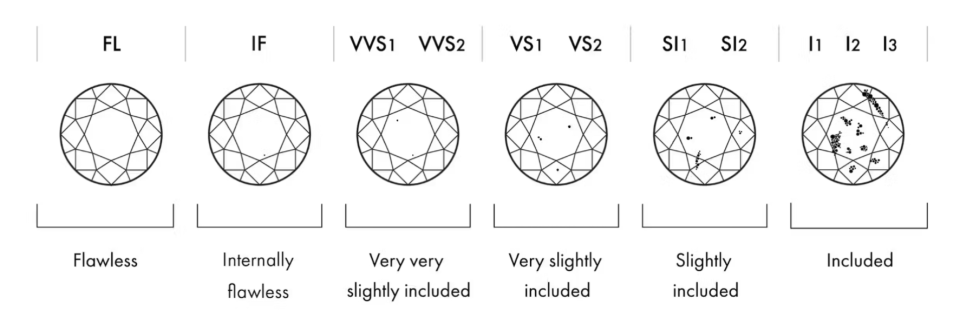
Clarity grades describe internal marks under magnification. VS1–VS2 is practically always eye-clean; often SI1 too, when the mark sits under the setting's edge. FL–VVS grades cost real money for a difference invisible without a 10× loupe. We tell you plainly, stone by stone, whether it is eye-clean — the exact question a certificate alone does not answer.
The certificate: read the stone, not the marketing
Every stone we set above 0.3 carats carries a GIA or IGI certificate — an independent grading whose number verifies in the laboratory's own database. It states the 4C grades, measurements and fluorescence. Do not fear that last one: faint-to-medium fluorescence almost never harms a stone's look, and often makes it better value.
Read next: Diamonds and the 4Cs · Lab-grown or natural diamond: an honest comparison from a maker who sells both · Where diamonds and gold actually come from — the certificates that mean something
Frequently asked
Which C matters most?
Cut. It creates the sparkle the eye actually sees. Choose Excellent or Very Good on round brilliants — then decide carat, colour and clarity.
Which clarity grade is enough?
VS1–VS2 is practically always eye-clean, often SI1 too. Higher grades differ only under a loupe — that money is better spent on cut or size.
Is fluorescence bad?
Usually not. Faint or medium fluorescence almost never changes how a stone looks and often improves its value. Only with very strong fluorescence is it worth seeing the stone first.
What is the difference between GIA and IGI?
Both are internationally recognised independent laboratories. GIA is historically the benchmark for natural stones; IGI grades much of the world's lab-grown supply. Either certificate verifies in the lab's own database.

Rauno Oidram — goldsmith, Keefirivunts
Designs the Keefirivunts rings and personally chooses every stone.