



Thin engagement rings are popular because they look minimalist and delicately feminine. But an engagement ring is a piece of jewelry that is often worn every day—ideally for decades. That’s why it’s worth thinking through the risks that come with wearing especially thin ring designs, particularly when the ring has a larger center stone or a row of stones.
Below is a clear overview of why a ring that’s too thin can cause problems over time, and what a practical “safe” range looks like.
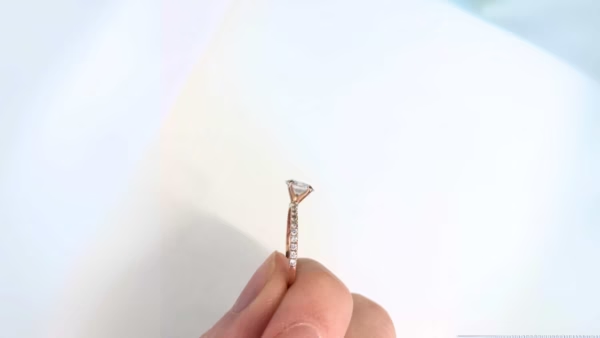 Quick Summary
- A ring that’s too thin bends and deforms more easily.
- Over the years, the metal wears down and the ring can become even more fragile.
- Resizing is more limited with a thin band and can weaken the ring even further.
- With stone-set rings, the risk increases that the settings fatigue and the stones start to wiggle or fall out.
- Recommendation for everyday wear: min 1.8–2.0 mm, depending on the stone and the design.
1) Higher Risk of Damage
Very thin engagement rings are naturally more delicate. They are more susceptible to:
- bending,
- deforming,
- and sometimes even breaking.
Everyday things—carrying a heavy bag, accidentally hitting your hand against a hard surface, the gym, tools, door frames—can affect a thin ring over time.
Why does this happen?
Gold is a soft metal. If the band is too thin, then:
- it gives way more easily,
- it can stretch,
- or it may lose its round shape over time.
2) Long-Term Durability
An engagement (and marriage) is meant to last a lifetime—so ideally an engagement ring should too. But thin rings may not hold up as well over many years.
Over time:
- the metal wears down,
- micro-scratches and friction affect the material,
- and the band can become even thinner than it was originally.
That’s why a ring with a stronger construction is often a better choice—not only for safety, but also so the ring still looks good after 10–20 years.
3) Limited Resizing Options
Life changes, and sometimes finger size changes too. The problem with a thin ring is that there may be less room for adjustment.
Additionally, every resize typically involves refinishing (filing/polishing), which can make the ring microscopically thinner—especially if it’s done multiple times over a lifetime.
A thicker band = more “margin” for the future.
4) Risk of Losing Stones
If the ring has a stone (or a row of stones), a thin band is especially risky.
Stones need support:
- prongs (settings) must remain strong,
- the band must be stable,
- and the setting shouldn’t “fatigue” from daily micro-impacts.
If the band bends, that stress transfers into the stone setting. Over time, the result can be:
- the stone starts to wiggle,
- prongs wear down or open microscopically,
- in the worst case, the stone can fall out.
5) Maintenance and Cleaning
A thin ring usually needs to be:
- checked more often,
- handled more carefully,
- and you need to react faster if something feels “off”.
Every small bend or scratch affects a thin ring more than a thicker band. Thicker rings:
- handle everyday life better,
- require less constant attention,
- and stay stable for longer.
Summary and Recommendation
The appeal of thin engagement rings is real—they’re minimalist and delicate. But an engagement ring is jewelry that should last for years. So it’s worth choosing a solution that combines beauty and durability.
Recommendation for everyday wear:
- at least a 1.8–2.0 mm wide band (depending on the stone size and placement)
In the end, the choice is personal, but awareness of the risks of thin rings helps you make a decision that fits the wearer’s lifestyle and lasts “forever”.